Friday, 11 May 2018

Mat Collishaw - Artist Research

Matt Collishaw

The ghostly nature of photography has long fascinated Collishaw, from an early work in which he restaged the fake fairy photographs that fooled Arthur Conan Doyle to a recent installation of terrifying crime-scene pictures. Here he uses VR and archival material to revisit the first ever photography exhibition in Victorian England. 


"Mat Collishaw can always find the intrinsically evil in photography. His subjects are often shocking and horrific – but it’s always the medium which is most disturbing. In The Eighth Day, Collishaw reproduces a photo of a real lynching found in an old book – but he does it in a monumental mosaic. Originally used in ancient times to immortalise gods, saints, and martyrs, mosaics were used to preserve timeless morals. But there’s something freakishly futuristic about Collishaw’s epic – black and white images are a modern invention, the miniscule tiles convincingly parody computer pixellation"  - Saatchi Gallery


Reflection

I have only just been introduced to the work of Matt Collishaw, and yet on first impressions it seems to possess highly visual qualities. The kind of work that holds a bunch of secrets a slowly draws out the moment that it tells you. I find the process the artist has used to be unfamiliar and shall have to research his portfolio in much more detail before passing judgement.


 Links


Salon to Biennial + Biennials and beyond - Research Books


Books:

Altshuler, Bruce (2008) Salon to Biennial: The exhibitions that made art history - Volume 1: 1863 – 1959. London: Phaidon.
 Altshuler, Bruce (2013) Biennials and beyond: The Exhibitions that Made Art History – Volume 2 1962-2002, London: Phaidon.

Reflection

These books have an intimidating amount of information in them, however I did find the images of display methods of use to my consideration as to how to present my work in a research institute such as the John Innes Centre. 


Out of Place - Exhibition at Nunnsyard Gallery


Reflection 


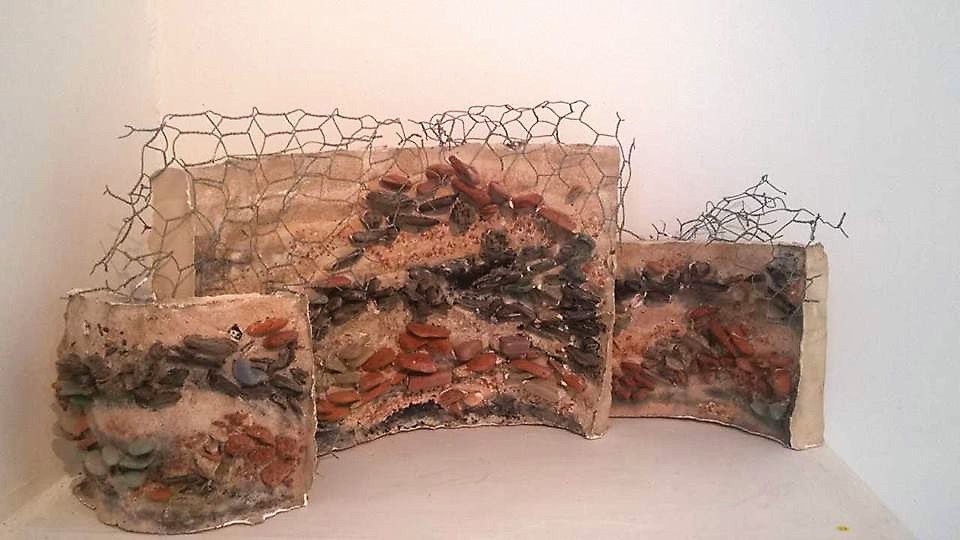
The materials that were brought together for the ‘Out of Place’ exhibition were of different molecular compositions and yet found commonality through the dialogue they exchanged with one another. This was most notable through the way they asked and answered questions that were raised by other objects. Elements of rust were offset by the smooth delicate curves of fine white plaster. The outline of the works resembled the incline and plummets of hills, which connected the work once again with the rich diversity of the natural landscape. These elements were just a few of the tactical devices that were engaged to create a space that would transform the viewer away into another place.From the start we had one objective in mind; to make a space that was simultaneously interactive and dormant. It was that objective that provoked us to split the gallery space in half, on one side three of us would us the space to display work that was material focused, from process, and out of place. On the other side, two performance based artists would engage spectators with a more hands on approach, using raw charcoal to draw, smudge and express. The areas divided created a slight tension within the space, as the objects from the gallery space looked out into the street. Many passers by would stop and look into the space, but as it held no secrets they would continue to walk on past once they had absorbed enough of its content. It was the interactive side that really drew people in off of the street, despite putting up posters and sending out invitation emails, the majority of the people that came to see the exhibition were strangers to it's existence. This meant that they were coming into it with open minds. I found that the majority of people that entered the space had children that dragged them in off of the street. I feel that now armed with that insight I would use that to my advantage next time I were to show work there. This is the first time I have exhibited in such a public venue, and I feel the process of collaboratively doing this show in a group made it a smoother experience for all of us.

Officina Corpuscoli - Artist Research


Another beautifully intriguing internet find, the organic nature of these sculptures connects the natural world with contemporary art yet again. These works relate strongly with the developing work within my own practice, as they balance the orderly systematic approach of archiving with the surprising unpredictable forms only nature could come up with. The natural tones employed within these works allow the eye to focus more on the structures themselves as they don't distract form it. However from these images it is hard to get a sense of the scale of these pieces; leaving me to only imagine there dimensions. Having said that I still find them delightful to look at as they transport me from where I am, and into a another world. This power makes them read as relics from a lost ecosphere.  


Sources

Blickling House notes and work


Research, development of ideas and experimentation #1


Resulting artwork 


Reflection


From the start of this unit, I was already strongly bewitched by the beauty of Blickling Hall, the Jacobean mansion owned now its its entirety by the national trust. This is the very start to my investigation into making site-specific work that would couple together the history of the building with the fusion of contemporary art. From my hearing stories told by staff I began to be intrigued to start my own research into Blickling. After reading up on the past owners of Blickling, I realised that the house had only even been inherited through marriage. This certainly seemed like a strong starting point to begin to develop work, the piece above featuring a miniature bridal dress sinking into and old house brick is full of connotations, to do with women keeping the home, for her husband. As well as the saying 'I married you not the house' this keep connection with the appearance of the sculpture. The house brick provides a grave like space for the dress to fall into. The emptiness of the dress opens up the narrative for this to be a number of brides, all falling into there death bed; pretty as they may be. Although I believe this work has strong potential, I also feel that it needs to be edited and developed further, this could begin by taking the materials to Blickling Hall itself and playing around the arrangement and narratives it creates through placement.