Saturday, 29 April 2017

Family Tree documentation


Family Tree


I looked into my family history, and was lucky enough to source some background information from my aunt Shirley, who was putting together family tree information sourced from Ancestry.com
The information sourced is all from my fathers side, I am particularly interested with the occupations they used to have as I think that a lot of that skill can be pasted down family lines. There is also a feeling of destiny and honour in following in your families footsteps which I will investigating into further throughout my degree. It occurs to me that since my family used to work on the land, farming, game keeping, shoe making ect, it is of no surprise that I feel a strong connection to the land and want to investigate further into using materials sourced from nature into my future works.


Marc Quinn: Artist Research


Emotional Detoxification 


 "There are drawings, frozen flowers, babies, Egyptian sculptures, family photographs, etc. I like the idea of showing how things come about, so this room is a mixture of ideas that became sculptures and ideas that never became sculptures and what's interesting to me is the mixture of the two."

"It’s a performance, and very theatrical. You are in this large room with a huge furnace and people are dancing around with big bits of glass. There’s a specific movement involved, because they have to keep the glass turning all the time.,.  putting it in the furnace, talking it out, pulling it. It’s like a dance, and I think that comes across in the work." Marc Quin 


"Emotional Detox is a series of seven sculptures made of lead and cast from parts of the artist's own body. In these works, which were inspired by traditional iconography of the seven deadly sins, the body has been devastated, suggestive of some kind of harrowing yet possibly cathartic experience. Like the Planck Density works, they point to the fragility of life and a moment of catharsis: to the shedding of a toxic material – lead – and a release from the body's epidermal perimeter. Small, square apertures in the sculptures are filled with candle wax, making the forms seem sacred like some kind of relic or devotional object. Quinn used photographs and collaged drawings to decide on the poses for each sculpture, which incorporate an element of chance since flaws and unpredictable textures from changing temperatures in the casting process are left as visible blemishes on their surface. The works were made at the time when Quinn overcame his addiction to alcohol and they deal with the idea of detoxification as both a physical and psychological battle." -  Quotation from Artist website.


Reflection:

I find Marc Quinn's work to be both Unique and thoughtful, clearly a result of emotion turmoil, his sculptural works are highly relevant to my current artistic practice. I have started to think of my work as a form DNA poetry, seeing hair, skin, nails and blood as capsules of the self. Quinn's work makes me question how far I could push this concept. I am particular interested in the way he documents his growing older with four busts of his hold own head, all made from his own blood. To me this documentation of the self with the self is fascinating, as it has both  archaeological and poetic qualities to it. Seeing the sculptures as not only physically resembling quin, by being authentically him inside, the work gains connotations of value and creates the impression that he needs some sort of protection. This may echo feelings the artist experienced whilst dealing with alcoholism, what is sure to say however; is that Quinn's work comes from a place deep within, and it is that honesty and vulnerability that is so attractive to viewers.  


Self


Unconventional and innovative, challenging and provoking, Self is a self-portrait cast of the artist's head made in 2006 from his own blood and then frozen. Emerging from the YBA movement, Marc Quinn is an artist whose work raises many questions about identity and the nature of portraiture, questions which go close to the heart of the work of the National Portrait Gallery. He is already represented in the Collection by his DNA portrait of the Nobel-prize-winning DNA scientist, Sir John Sulston, commissioned by the Gallery in 2001.
Self has become an enduring image of the Brit Art movement. There is no doubt that in the Gallery's collection this work would become iconic and would be much visited and debated. Needless to say, the Gallery has examined the technical issues very carefully. The work is designed so that it can be melted, recast and refrozen when it has to be moved. It is the fourth in the series so there is extensive experience in handling this sort of work.
The first blood head was made in 1991 and shown in the Sensation exhibition. Since then the artist has made a new cast every five years, documenting his own transformation and ultimate deterioration. The three earlier blood heads are all in overseas collections. The Gallery wants to present the latest in the series in London as a centrepiece in its contemporary collection and as a way of engaging with issues of representation of the human figure in contemporary culture.


Sources:


Sunday, 23 April 2017

Essex Witches


Essex Witches


"Essex is also famous for its involvement in the witchcraft trials that took place around 400 years ago. More witches have been hung in this county than any other in all of England. Mostly convicted on precarious evidence and confessions attained in unreliable circumstances, up to ninety witches were hung between the late 16th and early 17th century in Essex alone. When Matthew Hopkins, known as the Witch finder General, visited the county of Essex a staggering 19 witches were hung in one single day just on his accusation alone." - 


In 1566 the very first of the major witchcraft trials in England took place in Chelmsford, Essex. The accused were Agnes Waterhouse, her daughter Joan Waterhouse and another woman who was known to them named Elizabeth Francis. The women all came from the village of Hatfield Peverall and all were accused of colluding together in witchcraft


 Attitudes to death in the Middle Ages:


'Hell was the destiny for those guilty of mortal sins, while eternal life in Paradise was the reward for the good. The idea of Purgatory, a place where the souls of moderately bad sinners would go for a period of purification before being allowed into heaven, was accepted as a doctrine of the Catholic Church in the 1200's, and this idea came to shape much of the religious culture of the later Middle Ages. The living were encouraged to offer up prayers for the dead to lessen their time in Purgatory. This image of angels at the top of this page shows the death and funeral of Lucy de Vere, the first prioress of the Benedictine nunnery of Hedingam in Essex. When she died, around 1225, her successor sent the roll - over 19 feet long - to other religious houses, asking them to pray for her soul. As it passed around East Anglia and back and forth across southern England, each of them added an inscription asking for reciprocal prayers'. -  See more at: https://www.bl.uk/the-middle-ages/articles/death-and-the-afterlife-how-dying-affected-the-living#sthash.TbG2trNu.dpuf


Reflection:

Finding out that Chelmsford was a hot-spot for Witch Hunting, and having it my home town creates a strange correlation between my heritage and my beliefs. I have always sensed a feeling of unrest within the City and it has only been through further investigation into historical events that have transpired there, am I able to start to discover the cause for this negative energy that still remains within the foundations of the city. Within my artistic practice I have started performing rituals to heal the land. I do this in a number of ways, creating site specific rituals to disperse negative energies. Not just from historical injustices but from personal traumas steamed from the area. I have deduced that Chelmsford will need extensive healing to restore the balance of positive and negative energies.


Sources:


Norwich Witchcraft - Fye Bridge


Fye Bridge - Norwich


I went to the Records office at Norwich county hall, to find information about 'Fye bridge', and to gather any possible evidence of  involvement in the Norwich witch trails. I was privileged enough to get to see and handle the official documentation for the original planning application and specifications for the bridge dating back to the 18th Century.  The bridge was taken down and rebuilt,  the project was entrusted to a Mr. William Bough and Mr. George Smith who officially sign and placed there seal on documentation that states in which materials are to be used in the reconstruction of the bridge, and the way the process should take place. The stones and flint that could be salvaged from the original bridge were used to make the foundations of the current bridge. New Yorkshire stone, Bromley faced stone, English oak wood, were materials all employed in the making of the new bridge that was fitted with a granite curb, and Cast iron plates 7/8 of an inch to hold the structure firmly in place. The arch of the bridge would rise around 34 feet.


All the original documentation regarded 'ducking' connected to the Witch trails were 16th Century and therefore notoriously difficult to read and even more difficult to understand. Fye bridge was indeed one of the bridges officials would duck criminals, and as witchcraft was seen as a Criminal offence it was punishable in the same way the law would handle theft or infertility. Any bridge along the river Wenson in Norwich could have been used duck criminals, however along Quay side was particular popular. Today there stands a commemorative plaque alluding to the rivers darker history. 


Sunday, 9 April 2017

Medieval Witchcraft


Old beliefs of  Medieval witchcraft  


“Cunning-folk, who were also known as wise-women, wise-men, conjurors and wizards, were an integral part of English society right up until the early twentieth century. Over the centuries hundreds of thousands of people must have consulted them regarding a wide range of problems, but particularly those concerning affairs of the heart, theft, sickness and most important of all witchcraft. They were multi-skilled, or at least professed to be so. They practised herbalism, treasure-seeking and love magic. They revealed the identity of thieves and divined the whereabouts of lost and stolen property. The more learned cunning-folk also practised astrology, while the less learned pretended to be masters of the art. The most lucrative aspect of their business was the curing of those people and animals who were thought to be bewitched, and also the trade in charms to ward off witches and evil spirits.“


A cunning person is essentially a traditional folk-magic practitioner from the United Kingdom. It is believed those who were literate drew upon the magical grimoires and chapbooks of the times to add to their repertoires with some cunning folk’s reputations based solely on the grimoire they owned. Practices and services varied from region to region.  The practices of a Cornish Pellar might be completely different when compared to that of their Scottish or Irish counterpart. In Scotland, and possibly other regions, the wise women and men were divided into two categories: those that could practice only harm (buidseach or “black magician”), and those that could practice only good (cailleach or “spae wife”). Depending on what service a person needed they would go to one or the other for a curse or a cure. However, having said that, both types of cunning crafters were known to perform curses, it depended on the individual’s ethics.

According to the 19th century Orkney folklorist, Walter Traill Dennison, the Orcadian wise-woman, or spae-wife, was said to possess:
“…all the supernatural wisdom, some of the supernatural power, without any of the malevolent spirit of witches… The women of this class were skilled in medicinal and surgery, in dreams, in foresight and second-sight, and in forestalling the evil influence of witchcraft. Such women were looked upon with a kind of holy respect.“

In modern publishing the terms “hedgewitchery” and “hedge witch” are often mistakingly used to refer to cunning folk and their practices (see article on Hedge Witchery). Cunning folk are no longer an intrinsic part of British Isles society, but their services are still needed and called upon today. People still fall in love and get heartbroken, need healing or divination services, and desire for things to go their way when attempting to get a new job or house. The people who call upon the services of a wise man or woman are usually non-magical folk seeking a little magical help. There is also a wonderful interest in and revival of the old practices being taken up by newer generations. An example of a modern cunning man is Cecil Williamson, West Country Witch and the original founder of the Boscastle Witchcraft Museum – and while he may not have called himself such when he was alive – he fit the bill perfectly. Some good examples of modern wise women include Gemma Gary, a charm-maker and cunning woman in Cornwall, and Cassandra Latham, a village wisewoman also in Cornwall.


 Through podcasts I listened to on the BBC websites and YouTube, surrounding around myths, and cunning folk, and through research gathered online and through books, I have developed the opinion, that Cunning Folk were thought of as similar to witches however good of heart and providing a valuable service to the people who surrounded them. Witches were though to be dabbling in Black magic and in league with the devil himself. Cunning folk was the main port of call for the villagers, and were said to have a healing hand, know a large amount about herbs and natural remedies, as well as rituals and charms that would be spoken over to protect those most at risk of becoming sick. It was important to the Medieval communities to separate Cunning folk and white magic, with Supernatural Black magic, that was out to harm the innocent, known locally as witchcraft, so as not to get people who would be there main go-to in times of distress mixed up in the on going witch trails that were storming around Europe. 


Sources:


Runes - significance and meaning


Runes - Significance and Meaning 


Runes have two purposes, one - to be used as an alphabet


'The runic alphabets are called “futharks” after the first six runes (Fehu, Uruz, Thurisaz, Ansuz, Raidho, Kaunan), in much the same way that the word “alphabet” comes from the names of the first two Semitic letters (Aleph, Beth). There are three principal futharks: the 24-character Elder Futhark, the first fully-formed runic alphabet, whose development had begun by the first century CE and had been completed before the year 400;[4] the 16-character Younger Futhark, which began to diverge from the Elder Futhark around the beginning of the Viking Age (c. 750 CE)[5] and eventually replaced that older alphabet in Scandinavia; and the 33-character Anglo-Saxon Futhorc, which gradually altered and added to the Elder Futhark in England. On some inscriptions, the twenty-four runes of the Elder Futhark were divided into three ættir (Old Norse, “families”) of eight runes each,[6] but the significance of this division is unfortunately unknown.' 
                                                                                                                                                  
What were they made from?
Runes were traditionally carved onto stone, wood, bone, metal, or some similarly hard surface rather than drawn with ink and pen on parchment. This explains their sharp, angular form, which was well-suited to the medium.


  Runes - Second use


 Each rune was an ideographic or pictographic symbol of some cosmological principle or power, and to write a rune was to invoke and direct the force for which it stood. Indeed, in every Germanic language, the word “rune” (from Proto-Germanic *runo) means both “letter” and “secret” or “mystery,” and its original meaning, which likely predated the adoption of the runic alphabet, may have been simply “(hushed) message.”
Each rune had a name that hinted at the philosophical and magical significance of its visual form and the sound for which it stands, which was almost always the first sound of the rune’s name. For example, the T-rune, called *Tiwaz in the Proto-Germanic language, is named after the god Tiwaz (known as Tyr in the Viking Age). Tiwaz was perceived to dwell within the daytime sky, and, accordingly, the visual form of the T-rune is an arrow pointed upward (which surely also hints at the god’s martial role). The T-rune was often carved as a standalone ideograph, apart from the writing of any particular word, as part of spells cast to ensure victory in battle.
                                                                                                                                                                   

Reflection : 

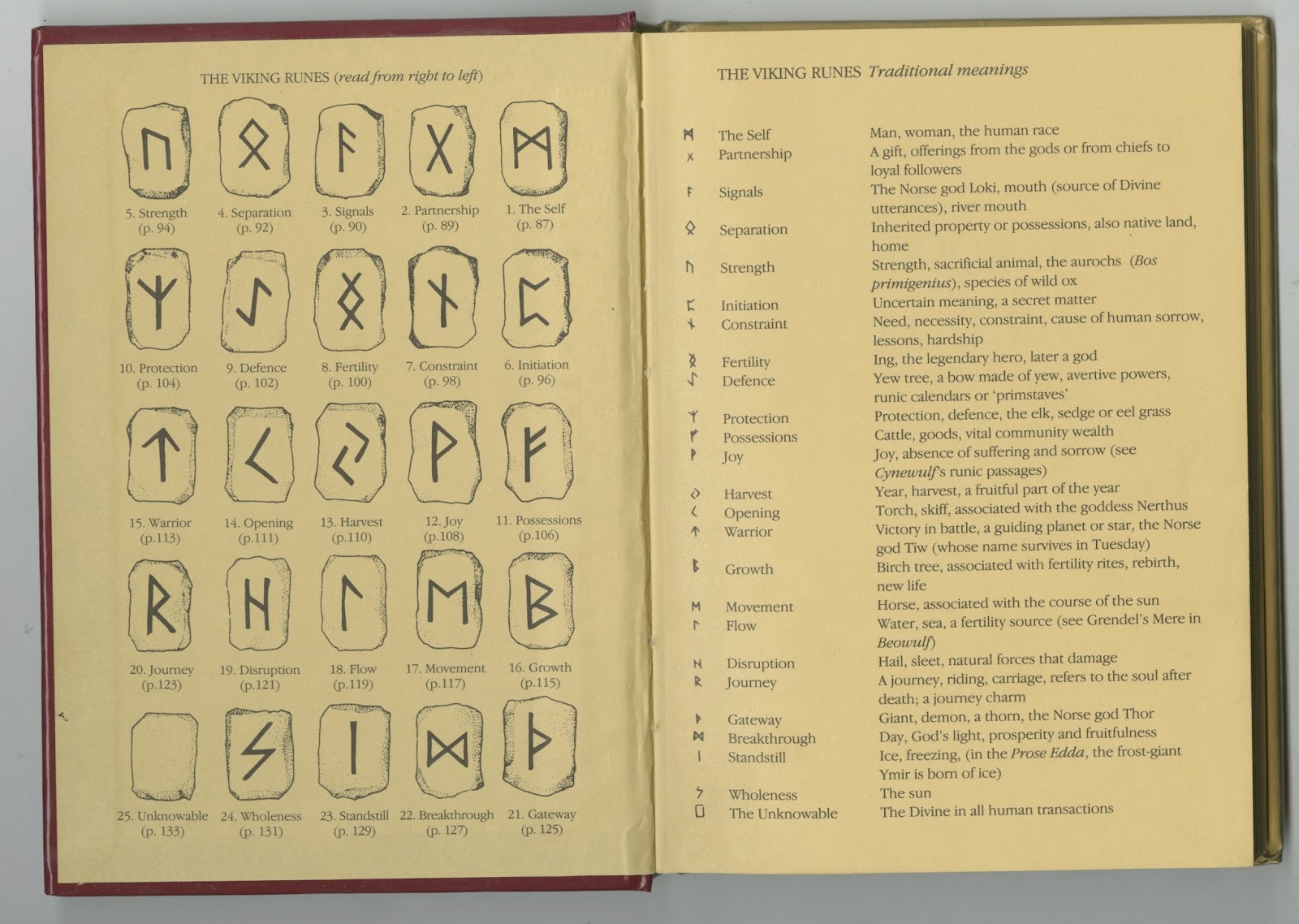
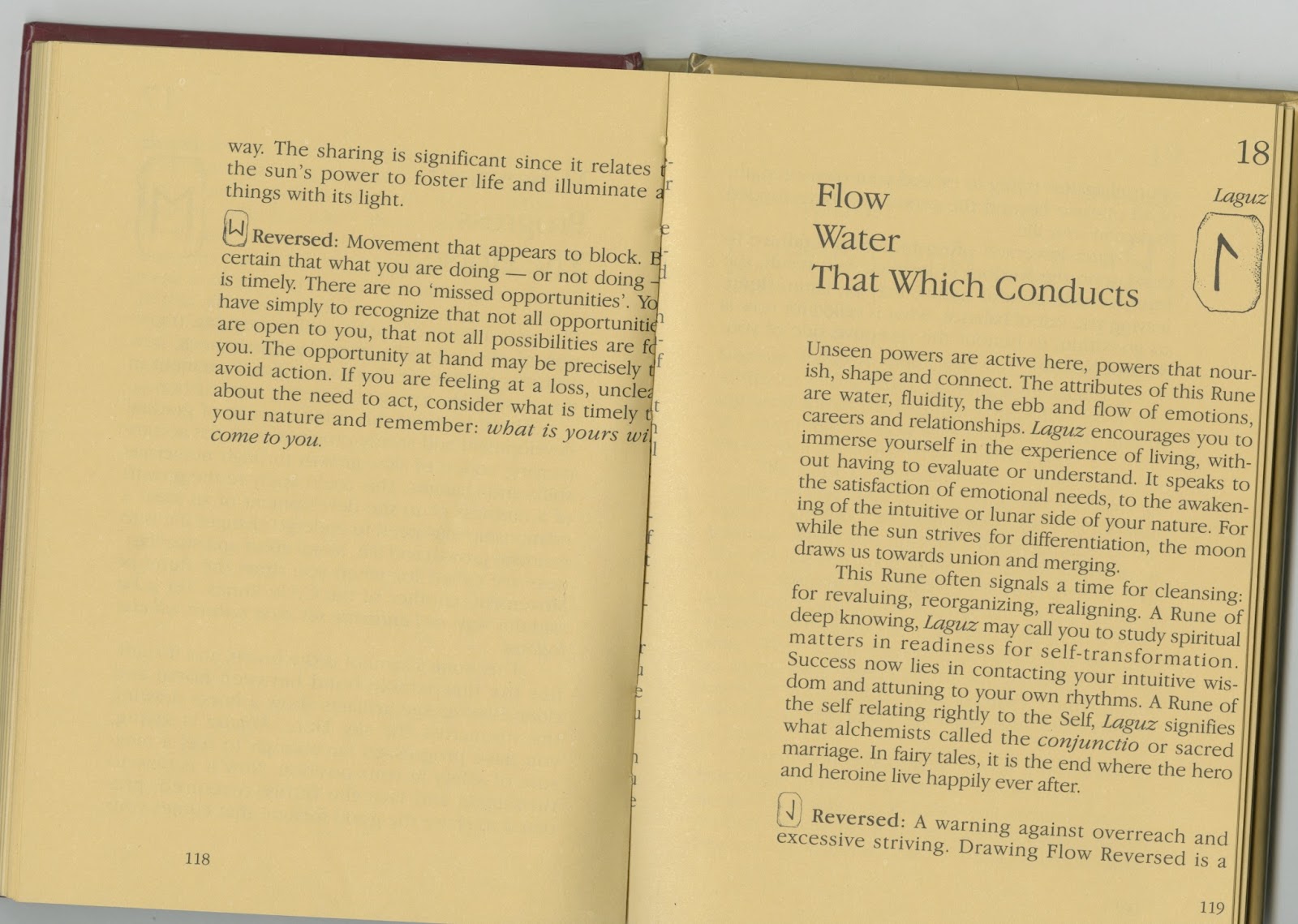
Runes have been of interest to me for many years now, as there forgotten language and hidden meanings create a impression of mystery and heritage. Much like tarot cards and other forms of divination, which were widely used in ancient Britain and across Europe. Life in the middle ages was particularly fraught with uncertainty regarding crops, livestock and fertility in general. Having an insight into the future holds a particular interest to us, even today, as our lives are just as fragile in many ways. The Runes pictured in the above images have a harsh gestural appearance, there deliberate marks echo the way in which they were carved. Runes, that symbolise marks of the gods have a powerful connotations tied to them and often appear through gestural poses in tribal dances.


Sources:


Book  used:

                             Blum. R (1993). The book of Runes . L.A California : Mandarian Offset . 87-135.